
|
Glycan Microarray Screening at the National Center for Functional Glycomics (NCFG)
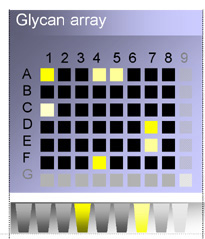
The NCFG glycan microarray facility (formerly the CFG Protein-Glycan Interaction Core, Core H) uses the CFG mammalian glycan array to analyze the glycan binding specificity of investigator-provided lectins, antibodies, antisera, microorganisms, and suspected glycan-binding proteins (GBPs) of human, animal, microbial, and plant origin. The current protocols used for these analyses require samples to be labeled or tagged in some way in order to fluorescently detect the primary binding to the glycans on the array.
Mammalian Glycan Array
The current CFG mammalian-type microarray (version 7) has 539 individual glycan targets. To generate the array, a library of natural and synthetic mammalian glycans with amino linkers is printed onto N-hydroxysuccinimide (NHS)-activated glass microscope slides (SCHOTT Nexterion Slide H), forming covalent amide linkages.
The printed glycan microarray format replaced the initial ELISA-based microplate array for routine screening of GBP specificity. The printed array format was validated by comparison to the ELISA-based array, as requested by the CFG's Steering Committee (see results here). Numerous array versions have been used over the years, with the largest containing 611 glycans, after which some glycans have been exhausted.
Microbial Glycan Array (MGM)
An additional microarray composed of bacterially-derived glycans/glyco-material is offered for investigator use. This array contains 313 compounds and is still available for request.
Submit Request for Assay
Requests for screening at the National Center for Functional Glycomics can be made through the following website:
https://research.bidmc.org/ncfg/microarrays
Submit Compounds for Next Upgrade of the CFG Glycan Array
A primary objective of the CFG was to increase the number and diversity of the glycans on the array to increase the coverage of natural glycan structures. To this end, the Glycan Array Synthesis Core (Core D) directed a major effort during its period of operation (2001-2011) toward preparing new N-linked and O-linked glycan cores and enzymatically elaborating them to obtain a diverse set of terminal sequences in the context of the different core structures. Core D ceased synthesis of new compounds as of December 15, 2010. However, if any investigators have new compounds for inclusion on future versions of the microarray, new slides can be printed at the NCFG with these glycans. If you are interested in providing compounds, please contact the NCFG at
https://research.bidmc.org/ncfg/contact-us
